
The Security Coup
How Communities of Care Stay Safe

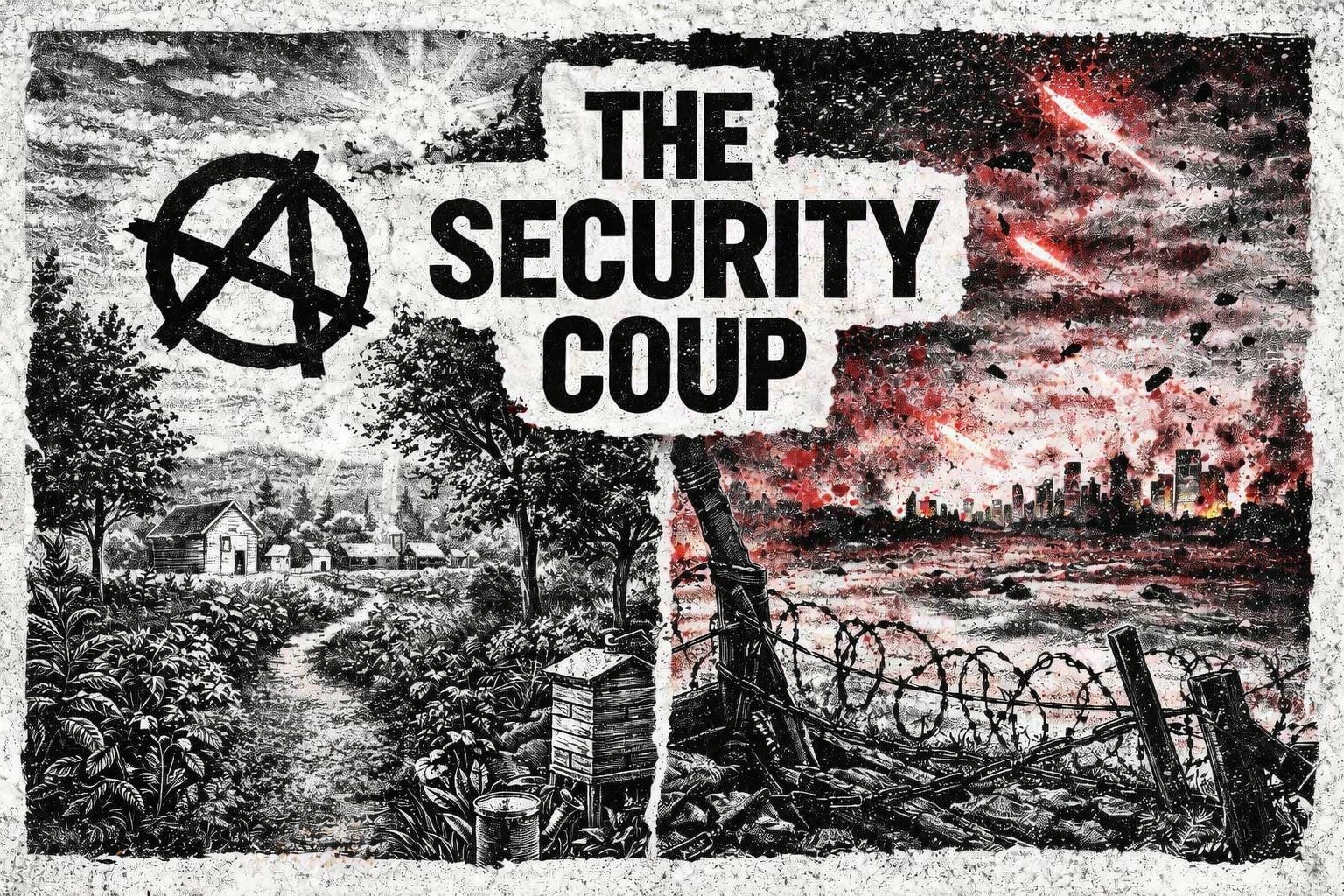
There are many ways a civilization can end.
It can end with fire, flood, famine, or a slow grinding shrug in the stock market, followed by a quiet announcement that nobody is getting pensions anymore. It can end with flags and speeches and men in uniforms and their bosses in suits insisting, with great passion, that the catastrophe is actually a return to greatness.
Or it can end the way it was ending for most of the outside world now, which was with a series of small system failures so mundane and repetitive that nobody could muster the energy to dramatize them properly. One week, there were shortages of antibiotics. The next week, the regional authority that still called itself “the state” discovered it could not pay the people who operated the state. Then came the rolling blackouts, the broken bridges, the late deliveries that simply never arrived, and a rising tide of armed men who looked like they had been provisioned by a cartel of nihilist fashion designers.
Fernvale watched all of this the way you might watch a neighbor’s house quietly sliding into the sea. There was sympathy, there was preparedness, and there was a certain resigned sense that if somebody insisted on building their entire home on the edge of a collapsing cliff, the only ethical thing to do was offer rope, tea, and a place to store their family heirlooms before gravity made all the important decisions.
Fernvale was not alone. It was a node in an expanding network of prefigurative post-capitalist communities, seed-sharing enclaves, repair cooperatives, water councils, and food commons, all connected by bike couriers and radio relays and the occasional human being who simply walked from one place to another with a bundle of pamphlets and an expression of deep personal commitment to being ungovernable.
The network had many names, none of which stuck, because nothing that existed to avoid hierarchy could ever agree on what to call itself without becoming suspicious of the coercion of language. People tended to refer to it simply as “the links,” or “the constellation,” or, if they were feeling particularly poetic, “the patchwork.”
The patchwork was growing. Unfortunately, so were the raiders.
They came in many forms. Some were organized, some were desperate, some were merely bored and armed. A few were remnants of collapsing security forces who had discovered that the uniform still worked if you were willing to ignore the law you used to pretend to uphold. And some were the entrepreneurial class of the apocalypse, men with rifles and spreadsheets who believed that when money stopped working, violence was the natural next currency.
Fernvale knew all this. Fernvale had plans. Fernvale did not panic. Which, as it turned out, was exactly what made Steve panic.
Steve experienced the outside world’s worsening condition with the quiet excitement of a man who had been waiting his whole life for people to finally admit he was right. Civilization was collapsing. Authority was failing. Danger was rising. Surely now Fernvale would stop its endless circles and celebrations and finally accept what Steve had been trying to explain for months. Surely now they would beg him to take charge.
It was at about this point, and not a moment before, that Steve discovered an important limitation of his worldview. Because Fernvale, when confronted with fear, did not grow more obedient. It grew more organized. Not in the satisfying way Steve enjoyed, with ranks and roles and clear lines of command, but in the irritating way that starlings organize, or mycelium, or a group chat that produces a functioning mutual aid response in under eight minutes. It was not chaos. It was not hierarchical. It was competence without ownership. And Steve hated it because it rendered him unnecessary.
The immediate cause of Steve’s next plan for taking over Fernvale arrived in the form of a courier named Pippa, who rolled into town on a bicycle that had clearly survived several apocalypses and was not impressed by any of them. Pippa brought a sack of dried beans and a folded piece of paper that smelled faintly of smoke.
The paper was a report from a neighboring enclave. It described a raid on a community granary two valleys away. It was brief. It was practical. He couldn’t see the full message, but he did see it ended with a sentence that made his skin tighten with delight.
They moved like they had done this before.
Steve ran it through his mind twice, then a third time, savoring the phrase the way a gourmand savors a sauce. Done this before. Repeatable. Predictable. An enemy. A threat.
A justification.
That evening, Fernvale gathered in the Council Meadow to discuss the report. The Council Meadow, in case you are imagining something with marble columns and ceremonial guards, was a patch of grass with a few stumps for sitting and a tree that had never once respected the sanctity of political deliberation. Clementine, being a well-respected goat, wandered through the gathering with the casual authority of someone who knew nobody would stop them.
Mara was there early, sitting cross-legged with a notebook open on her lap, already sketching out what looked like a web of connections rather than a plan. Mara coordinated threat awareness across several enclaves. This did not mean she was in charge. It meant people told her things, and she told other people those things, and then everyone pretended this wasn’t a form of power because it was happening politely. She was one of those people who made Steve uncomfortable because she possessed the single most offensive trait imaginable in a post-collapse world. She was quietly right.
She was not physically imposing, did not raise her voice, speak in slogans, or issue commands. And possibly what irked Steve most of all, she had the infuriating habit of listening to someone’s proposal, nodding thoughtfully, and then asking one question that caused the entire proposal to collapse like a tent with a missing peg.
Steve could not decide if she was dangerous or merely irritating. Either way, he watched her.
Rowan arrived with a basket of bread, a thermos of soup, and the calm gait of someone who could jog away from trouble if they felt like it, even if they rarely felt like it. Rowan was part of a rotating defense cohort that moved between enclaves, helping with patrols, escorting couriers, de-escalating conflicts at trade crossings, and occasionally lifting heavy things for elders who refused to admit they were elders.
Rowan did not look like what Steve imagined a protector should look like, which in Steve’s mind involved hardened eyes, grim silence, and the faint smell of gun oil. Instead, they looked like someone you might trust to water your plants. This, Steve suspected, was exactly the problem.
The circle formed as the report was read aloud. People asked the kind of simple, practical questions that made it difficult for fear to become theatrical in the way Steve could use.
“How many people?” “What weapons?” “What direction did they come from?” “What did they take?” “Did anyone get hurt?” “Was there a pattern?” None of which othered or demonized the raiders.
Steve listened, vibrating with the desire to seize the moment. He waited until there was a lull, then stood up with the solemnity of a man who has rehearsed his posture in the mirror.
“What happened to the granary,” Steve said, “is the beginning of what will happen to all of us unless we establish proper defensive protocols.”
There was a small pause. Someone’s dog sneezed.
Steve continued, undeterred by the universe’s lack of respect. “This is not the time for improvisation. This is not the time for casual optimism. This is the time for structure.” He reached into his satchel and produced, with a flourish that would have made sense if he were unveiling a new constitution, a laminated chart. It was color-coded.
The top left corner read: FERNVALE THREAT LEVEL SYSTEM.
The chart included five threat levels, each named after a historical catastrophe. Steve had spent a great deal of time choosing the names. It had felt important. He had, in fact, woken up at 3 a.m. on two separate occasions to revise the wording because the difference between “Worrying” and “Concerning” seemed, in his mind, like the difference between civilization and collapse.
“We are currently at Level Two,” he announced.
Mara, sitting on a stump with a cup of tea, raised a hand. “What does Level Two mean?”
“It means,” Steve said, and he enjoyed this because it sounded like authority, “that we implement Stage Two measures.”
“What are Stage Two measures?” asked Jules the potter, who looked like they had not slept since the previous decade and regarded new systems the way a cat regards a bath.
Steve, with what he felt was an even better flourish, held up a second laminated sheet. This one was titled: EMERGENCY MEASURES REGARDING PROTECTION.
It contained bullet points, sub-bullet points, and a small box at the bottom labeled “Escalation Pathway.” Steve watched their faces as he read it, waiting for the moment when the town collectively recognized that he was the only sane person left alive. Instead, he saw curiosity. Curiosity was not fear, he noted with an internal alarm bell ringing.
“First,” Steve said hurriedly, “we establish a standing guard rotation. Permanent shifts. A perimeter. We restrict access points. We implement identity verification.”
“What counts as identity verification?” asked someone in a knitted hat.
“Documents,” Steve said.
A faint ripple went through the crowd, the way ripples go through a pond when someone mentions taxes.
“What documents?” asked Mira.
Steve blinked. “Official documents.”
“From where?” Mira pressed.
Steve hesitated. Official was, in his mind, a self-evident concept. Official came from authority. Authority came from, well, authority. He was not accustomed to being asked where it came from.
He recovered quickly. “From us,” he said. “We issue them.”
Mara’s pen stopped moving. She looked up. “So we create an institution that issues papers,” she said, as if repeating something she had heard in a dream and found implausible. “And then we create an institution that checks the papers.”
“Yes,” Steve said, relieved that someone was finally tracking.
“And then,” Mara continued, “we create an institution that decides what happens when someone doesn’t have the paper.”
Steve felt a surge of satisfaction. “Exactly.”
Mara nodded slowly and wrote something down. Steve caught the words at an angle: paper spiral.
Rowan, meanwhile, had poured soup into small cups and was passing them around the circle. This was, Steve believed, a deeply unserious response to a security crisis. They offered Steve a cup. Steve did not want to take it. He took it anyway, because it would have been socially awkward not to, and Steve had learned that Fernvale’s soft power operated through the weaponization of politeness.
The soup was good. It was deeply annoying that it was good.
Rowan sat down and looked at Steve with mild interest, the way you look at a person who is explaining a hobby that you do not share but might be harmless.
“Can I ask a question?” Rowan said.
Steve, warmed by soup and the intoxicating aroma of imagined authority, nodded.
Rowan tilted their head. “Is this really an emergency,” they asked, “or is it just urgent in your opinion?”
A few people laughed. Not meanly. Genuinely.
Steve stiffened. “It is an emergency.”
Rowan nodded. “Okay,” they said. “Second question. Who exactly would we be checking papers for, and what do we do if they don’t have them?”
Steve opened his mouth.
He realized, with a small shock, that his plan had a box labeled “Consequences” but the consequences were vague, because writing the consequences down made them sound like violence, and Steve preferred his violence implied, like respectable people did.
“We deny entry,” he said finally.
Rowan’s expression remained calm. “And if they’re hungry?”
“They can go elsewhere.”
“And if elsewhere is burning?” Rowan asked, still calm.
Steve felt irritation rise. This was emotional sabotage disguised as questions. “We can’t take everyone,” he snapped. “That’s unrealistic.”
Mira murmured, “We already do,” as if this were a simple logistical fact, like rainfall.
Steve pressed on. He moved to the second portion of his plan, where his true genius shone.
“Third,” he said, “we establish a command node. A central coordinator for defense. Someone with authority to make rapid decisions without waiting for consensus.”
He said this slowly, letting it land. The meadow went quiet in a way that made Steve hopeful. He waited for someone to protest. When nobody did, he felt triumph, so he continued.
“That coordinator will be supported by a small security committee.”
Jules yawned. “Who picks them?”
“Obviously,” Steve said, “people who are competent.”
Mara looked up again. “Define competent.”
Steve frowned. “Competent is... competent.”
Rowan sipped soup. “I’m competent,” they said mildly.
Steve glared at them. “You’re... you’re not in charge of anything.”
Rowan shrugged. “That’s why I still sleep.”
A second wave of laughter moved through the circle. Someone coughed to hide it. Someone failed. Steve felt, with sudden clarity, the shape of the problem. Fernvale did not fear the outside world enough to accept hierarchy. They were treating danger like a project. He needed to raise the stakes.
So he did what Steve always did when he wanted to force the world into seriousness. He produced a map. It was, naturally, laminated. He had drawn it himself, which was evident because it contained far too many arrows and none of the arrows went anywhere that actually existed. He had labeled the valley edges with phrases like “Potential Infiltration Vector” and “Hostile Approach Corridor.”
He pointed to a spot on the map. “They could come from here,” he said. “Or here. Or here.”
“That’s most of the map,” Mira observed.
“Yes,” Steve said, pleased. “That is the point.”
Mara’s voice was gentle. “Steve,” she said, “do you know what the raiders want?”
“They want resources,” Steve said.
“Do they?” Mara asked. She held up her notebook, now filled with a web of lines connecting places and notes. “The raid two valleys over took grain and tools, yes. But they also took batteries, and medicine, and blankets. Which means they aren’t just stealing. They’re provisioning.”
Steve’s pulse quickened. “Exactly. Which means they are organized.”
Mara nodded. “Yes. Which means they have logistics. Which means they have constraints.” Steve blinked. Constraints were not the emotional response he was hoping for, but Mara continued, as if patiently explaining that gravity existed. “They avoid places with visible watchers. They hit places with single storage points. They don’t linger where people can respond quickly.”
Steve frowned. “So we need watchers.”
Rowan set their cup down. “We already have watchers,” they said. “We just don’t call them that because it makes people itchy.”
“It’s called a patrol,” Steve snapped.
“It’s called checking on the water line and escorting Pippa home,” Rowan replied. “We just do it in a way that doesn’t turn people into suspects.”
Steve looked at them sharply. “That’s naive.”
Rowan’s eyebrows lifted. “Is it?”
Steve leaned forward, suddenly earnest in a way that was almost convincing. “You think kindness stops violence?”
Rowan’s tone remained mild. “No,” they said. “I think violence escalates when people feel cornered. I think we keep people uncornered. You can call it moral purity if you want, but it’s just good tactics.”
Steve felt something twist in his chest. He disliked Rowan’s calm. He disliked their competence. He disliked, most of all, that their words sounded like strategy without the trappings of authority. It made his entire worldview feel, for a moment, like costume jewelry.
He recovered by doing what he always did when threatened. He became hostile. “That’s not defense,” Steve said coldly. “That’s wishful thinking. Defense requires readiness, discipline, obedience, and the willingness to use force.”
Rowan nodded, as if Steve had just described the weather. “Force is a tool,” they said. “So are rakes.”
Steve’s gaze flicked, involuntarily, to a pile of gardening tools near the meadow, left there from earlier in the day when someone had been planting something that would surely become a salad later. The tools lay in a tangled heap. A rake. A hoe. A spade. A pair of pruning shears. They were peaceful objects, until you imagined them otherwise. Which Steve did constantly.
“It’s exactly because those are tools,” Steve said, seizing on the point, “that they can become weapons. We need to secure them.”
Mira blinked. “Secure... the rakes?”
Steve heard, in her tone, the beginnings of mockery, and it made him furious. “Yes,” he said. “We should not leave potential weapons lying around.”
Jules rubbed their face. “We also leave rocks lying around.”
“Rocks are not organized,” Steve snapped.
Mara’s pen paused again. “Steve,” she said, “what do you want to happen when someone picks up a rake?”
“I want,” Steve said, “to know why they’re picking it up.”
Rowan’s mouth twitched in what might have been a smile or might have been indigestion. “Usually,” they said, “it’s because they want to rake.”
“That got another laugh, and Steve hated that the meadow had become a comedy club at the exact moment he was trying to deliver the birth of a security state.
He slapped his laminated chart against his knee. “You’re not taking this seriously,” he said.
Mara looked at him for a long moment. “We are taking it seriously,” she said. “We’re just not going to respond to danger by building the kind of structure that creates more danger.”
Steve opened his mouth, but Rowan spoke first. “Can I offer a counter-proposal?”
Steve’s stomach tightened. “Fine,” he said, as if granting mercy.
Rowan gestured, not theatrically, but practically, toward the circle. “We map the region together with the neighboring enclaves,” they said. “We set up radio check-ins at predictable times, so no one has to guess who’s alive. We establish escort routes for couriers. We distribute storage, so no one site is a single point of failure. We train more people in de-escalation and in basic defense, so protection isn’t centralized. And we decide, explicitly, what we will do if someone shows up hungry, armed, or both.”
Steve felt his frustration flare. “That’s exactly I just said,” he snapped. “Just without authority.”
Rowan nodded. “Yes,” they said, unbothered. “Without authority.”
Steve wanted to shout. He wanted to pound the stump like a judge. He wanted to insist that without authority, the plan was merely a suggestion. But Fernvale treated suggestions the way other societies treated laws. If you said something in a circle and everyone nodded, it became real. Not because someone enforced it. Because people did it. Which meant Rowan’s plan was not weaker than his. It was stronger. And Steve could feel, for reasons he could not name, that this bothered him more than the threat of raiders.
Mara raised her hand slightly, as if to apologize for interrupting. “Rowan’s plan aligns with what we’re already doing across the patchwork,” she said. “We can formalize it without centralizing it.”
Steve seized on the word. “Formalize,” he said. “Finally. Yes. And that requires a coordinator.”
Mara’s gaze was calm. “No,” she said. “It requires a shared schedule.”
Steve blinked. “That’s... that’s just coordination.”
“Yes,” Mara said. “Not command.”
Steve stared at her. He could not understand how someone could be so effective without wanting to seize the opportunity for dominance. He suspected she was lying to herself. Or lying to everyone. Or worst of all, being sincere.
The discussion continued. People spoke, asked questions, offered modifications. It was messy and slow and maddening. And then, because the universe has a cruel sense of timing, a radio crackled.
Pippa stood, holding the hand radio to her ear, her face suddenly serious. Everyone quieted, not because anyone ordered them to, but because they could feel the shift. A voice came through, distorted by distance and static.
“South road,” it said. “Three men. Rifles. Moving toward the ridge. Not fast. Watching.”
The meadow went still. Steve’s heart thumped. This was it. This was the moment when fear would finally assert itself. This was the moment when Fernvale would realize they needed him.
Steve stood up, his laminated charts trembling in his hand like scripture. “We implement Level Three,” he declared.
Mira looked at him blankly. “What’s Level Three again?”
Steve felt his soul leave his body briefly.
Rowan was already on their feet, not hurried, not dramatic. They moved like someone who had done this before, and who did not need to announce it. “Who’s closest to the south ridge?” Rowan asked. Two people raised their hands. Rowan nodded. “Go with Pippa,” they said. “Stay visible. Don’t approach. Just watch and report. Mara, can you relay to the other enclaves?”
Mara was already moving. Nobody asked Steve what to do. Nobody consulted his chart. Nobody cared about Level Three. Steve watched, appalled, as the town executed a response that resembled his plan in outcome and absolutely none of his plan in structure. He tried, desperately, to regain narrative control. “We need a perimeter,” he snapped. “We need an armed response.”
Rowan looked at him. “Do you have a rifle?” they asked. Steve did not.
It turned out that fascism, for all its love of weaponry, did not automatically grant one access to weapons in a society where weapons were treated as dangerous tools rather than identity accessories.
Rowan’s voice stayed calm. “Then you don’t have an armed response,” they said. “You have an opinion.”
Steve felt humiliation burn up his throat. “This is exactly what I mean,” he said. “You’re unprepared. You’re weak.”
Rowan stepped closer. Not threatening. Just close enough that Steve could see their eyes, steady and clear. “You’re shaking,” they said quietly. “Do you want to be useful?”
Steve’s jaw tightened. “I want to be in charge.”
Rowan nodded as if this was exactly what she suspected. “Okay,” they said. “You can help by making tea for the people who are going to stand watch. Fear makes you stupid if you don’t hydrate.”
Steve stared. He could not tell which was worse, being excluded from defense or being instructed to make tea like a domestic servant. He chose the only dignified option left to him. He made the tea with furious precision. He boiled water. He measured leaves. He poured with the grim focus of a man performing a ritual of resentment. He carried cups out to the square, handing them to people who accepted them with warm thanks that made his skin crawl.
“Thanks, Steve,” said Mara. “This helps.”
Steve’s hands trembled slightly as he refilled the kettle. He told himself it was anger. It might have been something else.
An hour passed before the reports came in. The three men on the ridge had stopped. They watched. They did not approach. They did not test the town’s response. They moved away, slowly, as if making a note.
Rowan listened, nodded, and said, “Okay.”
Steve waited for the dramatic escalation. There was none. Mara returned, sat down, and began sending messages to other enclaves. She was already turning the incident into a data point.
Steve could not stand it. “They’ll be back,” he said. “They were scouting.”
“Yes,” Mara said. “So we’ll adjust routes, shift storage, increase escorts.”
Steve slapped his laminated chart on the table beside the tea kettle. “This is exactly why we need centralized authority. To respond faster.”
Rowan looked at him. “We responded in under ten minutes,” they said.
Steve’s mouth opened, then closed again. He had not expected that.
“And nobody panicked,” Rowan added.
Steve heard it then, hidden beneath the words. Not pride. Not mockery. A quiet compliment. It struck him like a stone.
Steve’s voice came out harsher than he intended. “That’s luck,” he snapped.
Rowan’s eyebrows lifted. “No,” they said. “That’s practice.”
Mara looked at Steve with a calmness that felt, to Steve, like being observed by a mountain. “Steve,” she said, “you’re good at spotting danger. You just don’t understand what danger is.”
Steve’s chest tightened. “Danger is men with guns,” he said.
Mara nodded. “Yes. And danger is also building a system that makes everyone afraid of each other, because then the men with guns don’t need to break in. They get invited.”
Steve felt his stomach drop, as if the ground had shifted under his feet without permission. He hated that sentence. He hated how true it sounded.
He tried to recover by reaching for contempt. “So your plan is to be welcoming to armed strangers.”
“No,” Rowan said patiently. “Our plan is to be unpredictable in a way that doesn’t require a boss.”
Steve’s laugh came out bitter. “Unpredictable. That’s what you call this.”
Rowan shrugged. “It’s what raiders hate. They love systems. They love routines. They love central stores and single leaders.”
Mara’s voice was gentle. “They love someone they can threaten,” she said.
Steve’s skin prickled, because it was, in some deep part of him, comforting to imagine being that someone. The leader. The threatened. The necessary. And he realized he hated that too.
The meeting resumed. The town agreed to Rowan’s proposals as a set of shared commitments that would be carried into the regional network. Mara scribbled a schedule that looked like a woven pattern rather than a chain of command. People volunteered. People swapped roles. People offered to teach others. The pile of tools remained in the grass, still just tools, still not secured in an armory, still not turned into an excuse for policing.
Steve watched his Security Coup dissolve, not in a dramatic clash, but in something far more humiliating. Irrelevance.
When the circle finally broke, Rowan approached Steve with a cup of tea, as if this was not the single most insulting symbol in the universe.
“You did good,” Rowan said.
Steve stared at them. “I made tea.”
Rowan nodded. “Yes,” they said. “And nobody spiraled.”
Steve’s voice came out sharp. “This is not a victory.”
Rowan’s expression remained calm. “No,” they said. “It’s a lesson.”
Steve felt a flare of anger that was too intense for the situation. “You’re all so pleased with yourselves,” he snapped. “You think you can out-cooperate violence.”
Rowan did not flinch. “We don’t out-cooperate violence,” they said. “We out-network it. Violence is complex. It needs victims. It needs predictability. We deny it those things.”
Steve’s eyes narrowed. “And what happens when they come back with more men?”
Rowan’s gaze held steady. “Then we do what we always do,” they said. “We respond together, without giving anyone the thrill of being the hero.”
Steve heard it as an accusation. It wasn’t, but he felt accused anyway. It was simply a description of a world in which Steve’s preferred identity had no breathing room.
Later, alone in his room, Steve opened his notebook.
He wrote with furious neatness, as if precision could restore dignity.
Day 63: Hostile scout observed south ridge. Community response rapid. No centralized command. Rowan interfered with establishment of authority. Mara distributed intelligence in an annoyingly effective manner.
He paused, pen hovering.
He wrote another line, smaller, as if ashamed of it.
Rowan does not fear correctly. This is either incompetence or a new form of strength.
He stared at the sentence for a long time, then underlined “new” twice, as if trying to threaten it.
Outside, the town had already shifted. People were talking with neighboring enclaves, adjusting routes, building redundancy into storage, and training more escorts. There was no fear festival, no martial anthem, no speech about sacrifice.
Someone was laughing near the bakery, and Eduardo the Goat was doing what he loved most, chewing on a pamphlet.
The old world was ending, the patchwork was adapting, and Steve, in the middle of it all, was being forced to confront the possibility that protection might not be something you seize. It might be something you share.
He closed the notebook hard, as if that could shut the idea out.
It didn’t.
I love hopeful speculative fiction like this!
These illustrative pieces are quite immersive and the introduction to this one all too believable. The statements around violence feel like the tip of an iceberg of some deeper exploration of the subject and it would be interesting to find out more about this.
This is something you could write more about perhaps or share some reference material?