
The Dance Coup
How Bodies in Motion Resist Control

If you missed it, the first entry in this anthology series can be found here. You dont need the first one, but it does provide a bit of added context and entertainment.
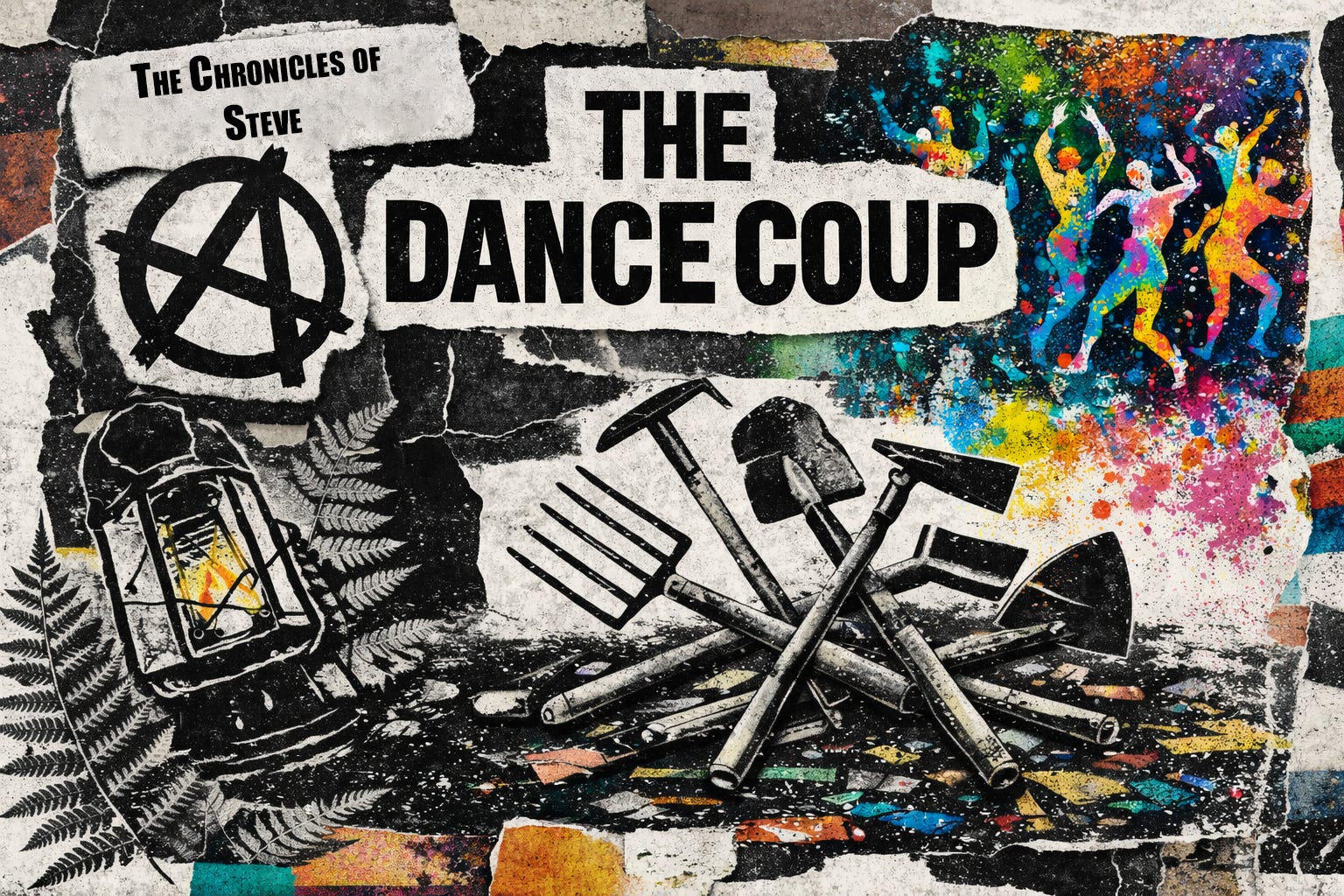
Fernvale was, at the best of times, a dangerously cheerful place. At the worst of times, it was precisely the same, which made the distinction more philosophical than practical. The townsfolk possessed a kind of relentless, collaborative joy that radiated outward like solar flare activity. Scientists from outside communities had once attempted to measure the phenomenon and left muttering that the data “resisted classification.”
Central to Fernvale’s emotional infrastructure was dancing. This was not the formal sort of dancing that required lessons, shoes, or even dignity. It was the spontaneous kind that erupted whenever a drum was tapped, a string was plucked, or a spoon accidentally clanged against a bowl. Some described it as a ritual of communal alignment. Others described it as cardio with joyful overtones.
Steve described it as tyranny.
He watched the dancers from a bench in the square, arms crossed tightly, jaw clenched in a manner normally reserved for people waiting far too long for their food at a restaurant. To Steve, the sight of swirling bodies, laughing faces, and unregulated movement was not a celebration. It was anarchy’s most insidious form: joy without permission. He could practically feel his hypothetical authority evaporating in the sunlight.
But then he saw the cluster of teenagers leaning against the Overpass Tree. The tree was not, strictly speaking, an overpass, though it carried itself with all the gravitas of one. It grew at the edge of the square, its branches forming a kind of natural awning under which Fernvale’s youth congregated to roll their eyes at things. The teens radiated disaffection, that rare mineral in Fernvale. They scowled at the dancers with a level of contempt Steve found deeply promising. In their slouched posture, their dramatic sighs, and their aggressively apathetic eye-rolling, he detected the first crack in the town’s armor.
Steve smiled, in what he imagined was a deeply strategic way, to himself. If Fernvale’s happiness was the engine of its social cohesion, then its disaffected youth were the loose bolts. And Steve, for the first time since arriving in this infernal utopia, finally felt he had something resembling a plan.
The Overpass Tree crowd consisted of six regulars and one rotating extra. Today’s cast included Riya, Jonas, Samir, Tamsin, and the twins, Ludo and Lina. They were perfectly normal teenagers in an abnormal level of safety and abundance, which meant their misery had nothing practical to attach itself to and was forced instead to orbit vague abstractions like “vibes” and “being seen.”
Steve approached them with the slow caution of a man entering a sacred site where the rituals were unfamiliar, and the priests had nose rings.
“Enjoying the festivities?” he asked, nodding toward the square, where an accordion had joined the fray, and the dancing was beginning to resemble a benevolent stampede.
Riya snorted. “You mean the compulsory happiness ritual?”
Steve’s ears pricked up. “Compulsory?”
Jonas made a vague gesture with one headphone. “If you don’t dance, somebody will eventually ask you how you’re feeling,” he said. “And then someone else will invite you to a feelings circle. It’s basically emotional taxation.”
This was, in Steve’s view, the first accurate critique of Fernvale he had heard since arriving. He sat down on the low stone wall beside them, leaving exactly the amount of space that suggested both authority and informality.
“I have noticed,” he said carefully, “that there is very little room here for people who do not wish to participate in… all this.” He waved at the dancers as if indicating a contagious illness. “It must be difficult to resist.”
“We’re not resisting,” Tamsin said quickly. “We’re… exploring alternative modes of engagement.”
“Sure,” Lina added. “Resisting would imply they have power over us.”
“Which they obviously do,” Ludo said. “Because we keep ending up here instead of somewhere not shaped like a drum circle.”
There was a murmur of agreement.
Steve let a moment of silence stretch, like a fisherman letting the line play out. “You know,” he said at last, “where I come from, people who feel as you do often form… groups.”
Jonas squinted at him. “Like a band?”
“Something like that,” Steve replied. “Except instead of making noise, you make history.”
This was not strictly true, but it sounded impressive, and teenagers are particularly vulnerable to phrases that imply destiny.
Over the next few days, Steve became a regular presence under the Overpass Tree. He did not preach; he listened. He asked questions like, “Do you feel heard in community meetings?” and “Are festivals designed around your voices or the elders’ nostalgia?” and, his personal favorite, “Has anyone ever told you that your refusal to participate might actually be an act of resistance?”
He was careful not to insult Fernvale directly. He praised the town’s ideals while gently suggesting that perhaps, accidentally, those ideals had begun to smother individuality. The festivals, he argued, were not neutral celebrations. They were mechanisms of social pressure.
“How many of you actually like dancing?” he asked one afternoon.
Two hands went up halfway, then retreated like uncertain hedgehogs.
“Exactly,” Steve said. “And yet dancing defines Fernvale. If you do not join, you are observed, queried, and invited to process. That is not freedom. That is soft control.”
The word control hung in the air with the gravitational pull of a dropped anvil. The teens, who prided themselves on detecting even faint traces of coercion, pounced on it.
“That’s why they keep calling us ‘the next generation of caretakers,’” Riya muttered. “It’s not encouragement. It’s conscription.”
Steve blessed her quietly in his heart. She had the makings of an excellent lieutenant. So he gave them a name: The Rhythm Resistance Front. They loved it. It was simultaneously dramatic, vague, and easily abbreviated to RRF, which looked good on the corner of notebooks.
He drew them a symbol. It was two parallel lines crossing a circle, like a no-entry sign that had received design input from a drum. He explained, in a tone of confidential gravity, that movements needed symbols to “anchor their narrative in the visual field.” They didn’t know what that meant, but neither did he, and that symmetry felt, to Steve, like leadership.
Steve knew from long study that successful authoritarian movements did not start with violence. They started with stories. So he crafted one.
“Dancing,” he told them in a low voice one evening, “is how Fernvale enforces conformity. They call it joy, but what it really does is erase difference. Every festival, every circle, every spiral of bodies convinces people that the only valid emotions are the ones that fit the beat.”
“That’s why I feel tired all the time,” Jonas said. “The beat is exhausting.”
“And what about people with different rhythms?” Steve asked. “Or no rhythm at all? Where is the space for your refusal?”
Silence. Then Tamsin, softly: “We become the problem they’re trying to heal.”
He let that sink in. It was a solid piece of analysis, terrifying in its accuracy and rich in manipulative potential.
“So,” Steve concluded, “you are not just grumpy teenagers leaning against a tree. You are the last guardians of authentic dissent.”
By the end of that week, they had stopped calling their gatherings “hanging out” and started calling them “cells.” It was, Steve thought, progress. Of course, he needed more than poetry to outlaw dancing. He needed an incident. Something shocking enough to make the town question its beloved rituals.
He chose the upcoming Full Moon Commons Dance, an all-night event involving lanterns, drums, and enough shared food to qualify as a mild logistical miracle. Every enclave in the regional network sent visitors. If he could turn that night into chaos, he might not only destabilize Fernvale but also embarrass the entire constellation of post-capitalist communities. Authority, he knew, fed on fear. He intended to set a table.
He did not, even at his most ruthless, intend to kill anyone. Steve’s imagination of violence tended toward strategic intimidation: smashed instruments, terrifying silhouettes, raised voices in the dark. His goal was panic, not bodies. Panic would be sufficient. Panic could be managed. Panic could be answered with structure. Besides, the whole point of authority was to have people alive to be dominated.
“Think of it as shock therapy for a complacent town,” he told himself sternly in the mirror. The mirror did not look convinced.
He armed the Rhythm Resistance Front with care. Nothing overt. No guns, no blades. He did not have access to those, and besides, they would have triggered Fernvale’s very efficient “we should talk about this” response earlier than he wanted.
Instead, he gave them gardening tools. Fernvale had plenty. A rake, a couple of sturdy hoes, a spade. Modified slightly with handles wrapped for better grip, and edges sharpened a touch, they looked less like instruments of cultivation and more like props from a very earnest play about revolution.
He instructed the teens to wear dark scarves over their faces, more for psychological impact than concealment. He helped them write chants about “our bodies, our rhythms” that could sound like a liberation movement if you weren’t paying attention.
The plan was simple in outline and complex in timing:
Wait until the dance reached its ecstatic peak. Extinguish several lanterns at once. March into the square in formation, chanting, striking the ground with their tools. Smash the central drum. Declare dancing a weapon of social control and demand an immediate town-wide moratorium “until we can investigate emotional coercion.”
He pictured the dancers stumbling back, eyes wide, the music collapsing into silence. He imagined cries, confusion, and maybe even somebody shouting, “We need structure!” He saw himself stepping forward, the only calm voice in the chaos, offering order, protection, and above all, protocols.
It was, he admitted to himself, an excellent plan.
The night of the Full Moon Commons Dance arrived luminous and unhelpful. The square glowed with lanterns and bioluminescent decorations made by children who insisted on calling them “moon spores.” Musicians from three neighboring enclaves had come with hand drums, fiddles, and an instrument that looked and sounded like a cross between a harp and an irritated seashell.
People moved in great arcs and spirals, a choreography half-learned and half-improvised. From his position near the edge of the square, Steve could feel the rhythm pressing against him like a warm tide he refused to acknowledge. He tried to adjust his tie and glanced toward the Overpass Tree, studiously ignoring the fact that this clip-on tie was the closest he could find to something resembling the officious remnants of the politicians of yesteryear that he so deeply admired.
Six dark-scarved figures watched from the shadows, gripping their tools. The sight filled him with something dangerously close to pride. They were organized. They were committed. They believed him.
A whistle sounded. This was their signal.
The lanterns went out in a sudden cascading hush. Someone had slipped water into the oil basins; someone else had quietly loosened the hooks. Darkness wrapped the square. The music faltered, then stopped. For the first time Steve had ever seen, Fernvale’s dancers stood frozen.
Into that silence marched the Rhythm Resistance Front.
Their boots thudded in deliberate unison. The tools struck the ground in time, a harsh counter-rhythm. Jonas’s voice rose first, cracking but determined.
“No more forced joy!”
Tamsin followed. “Our bodies are not your festival!”
The others took up the chant. “No more forced joy! Our bodies are not your festival!”
It worked. For a moment. Steve watched as confusion rippled through the crowd. Parents clutched children. The musicians stepped back from their instruments. Someone whispered, “What is happening?” in the thin voice people use when they are trying very hard not to panic.
Steve stepped forward, heart pounding with the terrible exhilaration of a man who has just found the off switch on a culture. The central drum sat before him, wide and vulnerable. He raised the spade. This was not a metaphor anymore. Steve understood that with a clarity that made his mouth go dry.
Someone stumbled backward in the dark. A child cried out, sharp and sudden. One of the lantern poles clattered to the ground and rolled, its flame guttering dangerously close to a dropped scarf. For half a breath, no one moved. Steve felt it then, unmistakably: the moment where fear stops being theatrical and starts choosing targets.
And at that exact moment, old Elias walked into the square carrying a lantern.
Elias was Fernvale’s closest thing to an elder, which mainly meant he remembered more past mistakes than anyone else and had the patience to bring them up at inconvenient times. His hair resembled a dandelion in philosophical decline. His lantern was an ordinary one, no magic, just a stubborn flame protected by glass.
He did not shout. He did not rush. He simply walked slowly through the chanting line of teenagers, as if they were a weather pattern he had been expecting.
“Careful with that drum,” he said mildly, nodding to the spade in Steve’s hands. “The shell took three days of collective argument to pick.”
The teens wavered. This was not the terrified reaction they had rehearsed. No one thought this was performance art. Not tonight. Too many hands were shaking. Too many people were looking around to make sure their beloved town was safe. Elias turned, raising the lantern so its light fell on their scarves, their clenched jaws, their very earnest outrage. “I hear you don’t want to dance,” he said. “Fair. Neither do my knees. But I’m curious why you thought you needed weapons to say so.”
“We’re not being heard,” Riya shot back. Her voice shook, but the anger was real. “If we don’t join, everyone thinks something’s wrong with us. You call it care. It feels like surveillance.”
A murmur moved through the crowd. Not the murmur of a mob, but the murmur of a community being very rudely invited to self-reflection in public.
Elias nodded slowly. “Sounds like we made a sacred cow out of dancing,” he said. “Never a good idea. Cows get nervous.”
Jonas tried to swing his rake for emphasis. Elias simply took a half-step closer, lantern steady. “If you hit that drum,” he said gently, “we will repair it. If you hit a person, we will stop you. Either way, we’ll still want to know why you felt this was your only option.” Jonas visibly faltered. “What you’re holding can kill someone,” Elias said, not accusing, just stating a fact that refused to be debated.
Steve could feel the moment slipping. This was supposed to be fear, not family therapy. He cleared his throat. “The point,” he said loudly, “is that joy has been weaponized. These young people are taking a stand against an emotional regime—”
“Oh, Steve,” someone groaned from the crowd. It was Mira, the carpenter, eyes sad rather than angry. “Are you recruiting again?”
There was an exasperated laugh. Steve flushed with rage and shame when he realized it was not derisive, but was instead tired, fond, and worried. The spell cracked further. The dancers were no longer a mass; they were individuals seeing their own children holding sharpened hoes and realizing, with a jolt, that something was indeed wrong, but not in the way Steve intended.
Elias looked around the square. “New proposal,” he said. “We pause the dance. We form a circle. We listen to the kids complain about us for as long as they need. Then we decide together what to change.”
“You can’t just… process your way out of this,” Steve protested. “They are armed. They have taken the square. This is an insurrection!”
The teenagers glanced at one another, visibly pleased by the word. An insurrection sounded important.
Elias shrugged. “If it is, it is the most polite one I’ve ever seen. Nobody’s even knocked over a lantern.”
Tamsin hesitated, lowered her hoe slightly. “We… don’t actually want to hurt anyone,” she muttered. “We just wanted you to stop assuming we like the same things you do.”
From somewhere in the crowd, a voice called, “Fair enough!” Another added, “Meetings are always at your parents’ bedtimes anyway.”
Laughter, this time shaky, but real. The tools dipped further. Someone near the back of the Rhythm Resistance Front began to cry, quietly and mortifyingly. Lina pulled off her scarf and wiped her face with it, which rather ruined the menacing effect.
Elias turned the lantern toward Steve. “You’re good at spotting pressure points,” he said. “You were right. We were pushing joy instead of inviting it. Thank you for helping us see that.”
Steve stared at him, appalled. “This is not a learning opportunity,” he said. “This is a coup.”
“No,” Elias replied calmly. “This is a safety briefing that came with costumes.” He addressed the teens again. “All right. Rhythm Resistance Front, you can stand down from this theatrical intimidation. Instead, here’s a new task, help us design spaces where you can not dance without being treated like a problem.”
Riya let her rake fall to the ground with a clatter. “You mean… like, an official lounge for people who hate festivities?”
“Exactly,” Elias said. “We will even give it a worse name so you can invent a cooler one.”
The teens huddled instinctively, conspiratorial energy redirected. Within moments, they were arguing fiercely about acronyms. The gardening tools lay abandoned like discarded exoskeletons. Riya kept staring at the rake on the ground, as if trying to work out when it had stopped being a prop and started being a mistake. The square breathed. Lanterns were relit. The musicians, after some cautious glances, began to tune again.
Steve stood alone beside the untouched drum, spade still in hand, the architect of a near-miss that had once again been folded into Fernvale’s maddening, resilient process.
Later, in the quiet of his room, he wrote in his notebook with ferocious precision.
Day 47: Operation Dance Ban failed. Youth radicalization partially successful but immediately co-opted into participatory governance structure. Misjudged escalation window. Probability of irreversible harm higher than anticipated. Community demonstrated alarming capacity to transform potential violence into policy reform. Town now has a designated Non-Participation Lounge, widely celebrated as my “accidental contribution.” I hate this place so much, and I cannot understand their love of transformative change.
He tapped the page with the end of his pen. Somewhere outside, faint strains of music drifted through the window, but they were joined now by another sound: laughter and conversation from a separate gathering, low and intense, the Rhythm Resistance Front discussing agenda items for their newly recognized Youth Autonomy Council.
They had, he realized bitterly, gained more legitimate influence in one evening than he had in months of scheming.
Steve closed the notebook and stared at the ceiling.
The problem with trying to break a society built on mutual aid, he reflected, was that every blow landed like a hammer on hot metal. The system did not shatter. It reshaped.
He did not know it yet, but in the next meeting of the regional enclaves, Fernvale would present a new protocol on “Recognizing and Responding to Authoritarian Organizing Patterns Among Youth,” citing “the Steve Incident” as a key learning moment. Other communities would adopt it gratefully.
In the official minutes, he would be thanked.
That, he decided, was the real violence.
Poor Steve, thwarted again. I also feel some fondness for him. Tortured by gratitude! He needs to fall in love or have some sort of spiritual awakening haha This was another fun read, lots of smiles and some chuckles. And totally resonate with those teens. Always include a non-participation corner at my gatherings 🤗
I need to understand more about anarchist systems. What should I read.
One of the biggest questions I have is how can a system protect the vulnerable without authority and power to protect?
Thank you for your time.